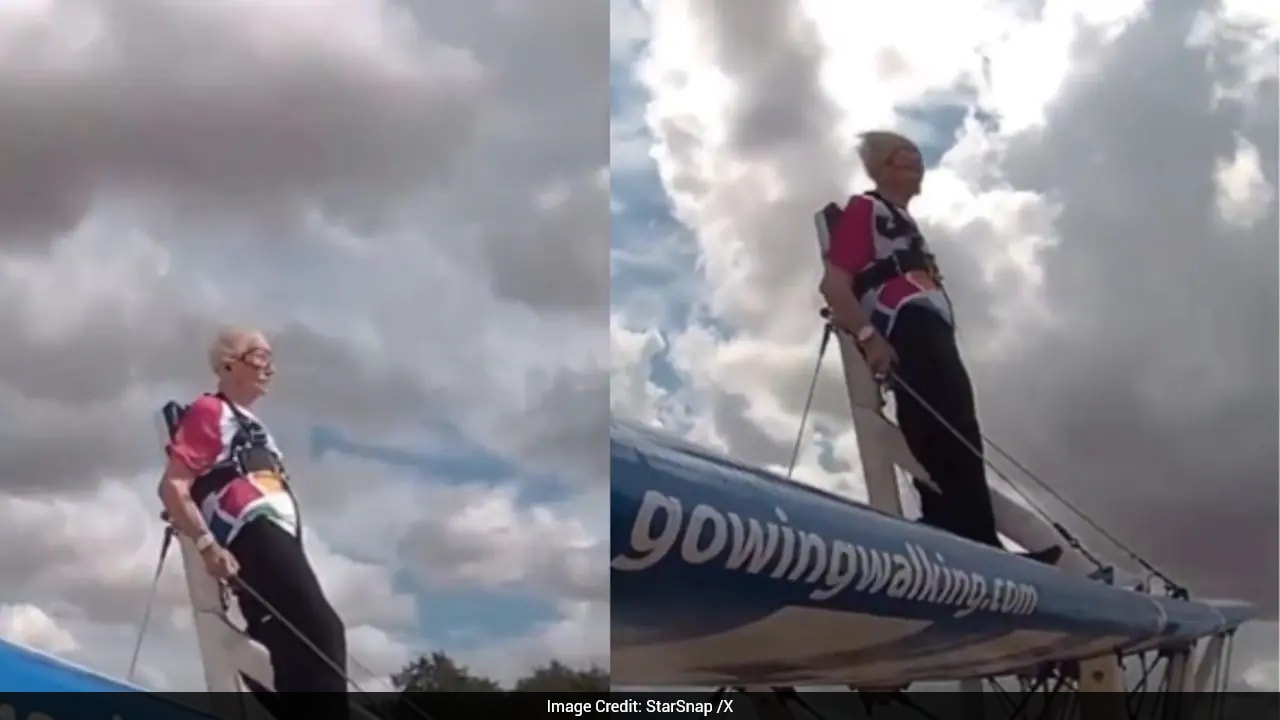
Most people in their late nineties spend their afternoons in a comfortable armchair with a hot cup of tea. Betty Bromage spent hers strapped to the top wing of a biplane hundreds of feet above the English countryside, grinning while the pilot pulled a loop through the clouds.
At 97 years old, the retired nurse from Cheltenham, England, just shattered her own Guinness World Record as the oldest female wing walker. This was not a lucky one-off stunt for social media clout. It was her sixth time climbing onto an aircraft wing since taking up extreme aviation at 87.
What makes this record even more remarkable is what happened just months prior. In 2025, Betty suffered a severe stroke that left her with lasting speech difficulties. Most people would take that as a clear signal to slow down. Betty used it as motivation to raise money for the hospital unit that saved her life.
If you think getting older means giving up on adventure, Betty Bromage is living proof that you're wrong.
The Moment a 97 Year Old Reclaimed Her Guinness World Record
Taking off from Rendcomb Airfield in Gloucestershire, the flight required extreme physical courage. Under Guinness World Record rules, a wing walker must stay airborne for at least five full minutes, including takeoff and landing. Betty did far more than sit tight for five minutes. She stood tall in the rig as the biplane swooped, rolled, and completed full acrobatic loops.
When the plane finally touched down on the grass runway, she wasn't shaken. She was thrilled.
"Bit bumpy, but it was great," she remarked after stepping down.
Betty originally set the Guinness World Record for oldest female wing walker four years earlier at age 93. By taking to the skies again at 97, she reclaimed the crown from herself, pushing the boundary of human endurance even higher.
Honestly, the physical mechanics of wing walking are terrifying for people half her age. You stand on a rig mounted to the upper wing of a vintage aircraft, completely exposed to the elements. Propeller wash hits your face at speeds well over 80 miles per hour. The force presses hard against your chest while the ground spins hundreds of feet below you.
Betty takes all of that in stride. For her, the hardest part of the entire ordeal isn't flying through the sky upside down.
"The only problem is getting up on the wing because I'm quite short," she joked after her flight. "Once you're up there, no problem. The fairground is a lot worse."
How a Former Nurse Ended Up On Top of a Flying Biplane
People often ask how someone decides to climb onto an airplane wing in their late eighties. For Betty, it started with a simple television commercial.
She was 87 years old, living a quiet retirement in Cheltenham. She saw a wing walker on TV and thought to herself that it looked like fun. She didn't overthink it. She didn't ask for permission or worry about what her neighbors would say. She just booked a flight.
Before taking up extreme aerial stunts, Betty spent her working life as a nurse. Decades spent caring for sick and dying patients gave her a sharp perspective on how fleeting life really is.
During her nursing days, a specific passage posted on a hospital wall caught her eye: "We pass through this world but once. Any good we can do, any kindness we can show, do it now. Do not defer or neglect it. You will not pass this way again."
That quote became her personal creed.
As age began taking away some of her daily independence, she refused to let frustration turn into defeat.
"I'd just get bored of life otherwise," Betty explained to reporters. "I can't drive, I can't see very well and I get a bit frustrated. So, I want to do the things I can do."
That attitude explains why she keeps returning to the airfield. Loss of vision or losing a driver's license causes many seniors to shrink their world down to their living room walls. Betty did the exact opposite. She traded driving a car for flying on a biplane.
Fighting Back From a Stroke to Fly Again
In August 2025, Betty faced a massive hurdle. She suffered a stroke that hospitalized her and damaged her speech.
A stroke at age 96 is often a life-altering event that shuts down independent living entirely. The medical team at Cheltenham General Hospital worked tirelessly to help her recover. While the stroke left her with lingering speech difficulties, her physical determination remained untouched.
"They treated me so well," Betty said of the hospital staff. "It affects my words, but the rest of me is fine."
Instead of feeling sorry for herself, she turned her recovery into a mission. She decided her sixth wing walk would serve as a major fundraiser for the hospital's stroke unit, raising money to buy specialized medical equipment for future patients and staff.
Imogen Sims, a representative from the Cheltenham and Gloucester Hospitals Charity, praised Betty's courage. "To take on such a daring challenge to support our team is amazing," Sims noted, highlighting how the funds raised will directly improve patient care.
Recovery isn't just about physical therapy exercises in a clinic. For Betty, recovery meant getting back on top of a plane. She refused to let a medical diagnosis dictate what her body could achieve.
What Wing Walking Actually Demands From the Human Body
To truly appreciate what Betty accomplished, you have to understand the intense physical forces involved in wing walking.
This isn't like sitting in first class on a commercial airliner. Wing walking exposes the human body to physical stresses that challenge trained athletes, let alone a 97-year-old grandmother.
- Extreme Wind Resistance: At speeds exceeding 80 knots, air pressure pushes against your chest with tremendous force. Maintaining your balance and keeping your head steady requires continuous core engagement.
- G-Force Variations: When a biplane pulls into a steep climb, bank turn, or acrobatic loop, gravitational forces shift rapidly. These G-forces push blood away from the brain, demanding strong cardiovascular health to avoid dizziness or blackouts.
- Severe Windburn and Temperature Drops: Air temperature drops significantly as altitude increases. Combined with high-speed wind, exposed skin faces extreme cooling and intense pressure.
- Climbing and Rigging: Getting onto the aircraft wing requires scrambling up a small ladder and stepping carefully across narrow wooden wing ribs before being strapped into the steel safety harness.
Most young people feel intimidated just looking at the rig. Betty looked at it, climbed up, and asked the pilot to do loops.
The Mindset That Makes 97 Look Like the New 70
We live in a culture obsessed with youth, yet terrified of aging. We treat getting older as an inevitable decline into fragility and limitation.
Betty Bromage crushes that narrative.
Her secret isn't some secret anti-aging cream or a fancy diet. It's her mental framework. She lives by one unyielding principle: never say the word "can't."
"You mustn't say the word 'can't,'" Betty insisted following her flight.
When vision loss took away her ability to drive, she didn't focus on what was lost. She focused on what was still possible. When a stroke impaired her speech, she didn't isolate herself. She organized a public stunt to help others suffering from the same condition.
That psychological resilience is something modern medicine is only beginning to understand. Studies on super-agers consistently show that purposeful activity, social contribution, and refusal to adopt "elderly" mindsets directly correlate with longer, healthier lives. Purpose keeps people alive far more effectively than caution does.
Betty isn't finished either. She is already making plans for her next big milestone.
"I'll have to think of something when I'm 100," she grinned. "Something special."
Lessons from Betty Bromage to Apply Right Now
You don't need to climb onto a biplane wing tomorrow to adopt Betty's record-breaking mindset. But you can immediately apply the principles that keep her thriving in her late nineties.
Here is how to put her approach into action today:
Delete "Can't" From Your Daily Vocabulary
Stop listing reasons why you're too old, too tired, or too out of shape to start something new. If Betty can take up wing walking at 87, you can start that new hobby, fitness routine, or career pivot today.Convert Setbacks Into Service
When life throws a major curveball, like a health scare or job loss, shift your focus outward. Find a way to support the doctors, friends, or organizations that supported you during your low points. Purpose turns pain into action.Adapt When Capabilities Change
Losing a key ability like driving or sharp eyesight is frustrating. Don't let it shrink your horizon. Pivot to activities that work with the strengths you still have.Never Act Your Age
Society builds invisible cages made of age-based expectations. Throw them out. Curiosity and thrill-seeking don't expire unless you let them.
Betty Bromage proved that life doesn't stop until you decide to sit down. Get up, throw out your excuses, and find your own wing to walk on.