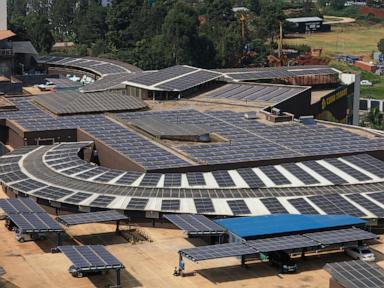
Africa wants energy independence, but escaping the orbit of global manufacturing giants is harder than politicians admit. Across the continent, leaders are pushing to manufacture photovoltaic panels locally rather than simply importing finished goods from overseas. It sounds like a straightforward win for self-reliance. Yet, the reality on the ground tells a much more complicated story of supply chains, financial realities, and unmatched industrial dominance.
You can't talk about solar energy anywhere in the world today without bumping into Beijing's massive industrial footprint. China controls over eighty percent of global solar component manufacturing, spanning every single stage from polysilicon refining down to module assembly. When African nations try to build homegrown solar assembly plants—such as recent joint ventures and regional initiatives in places like South Africa's Mpumalanga province—they aren't stepping away from Chinese influence. They are actually importing Chinese machinery, engineering expertise, and raw materials to get those factories off the ground.
The Trap of Import Dependency
For years, the standard playbook for electrification across Sub-Saharan Africa relied on cheap, imported panels flooding in from Asian factories. It worked wonderfully for driving down installation costs. Millions of households and commercial businesses gained access to reliable off-grid power without waiting decades for centralized utility grids to reach them.
However, relying entirely on foreign imports leaves local markets vulnerable to global shipping snarls, currency fluctuations, and sudden price shocks. When international freight rates spike, the cost of powering a rural clinic or a commercial warehouse in Nairobi or Lagos skyrockets. Governments realized they needed to pivot. Building domestic manufacturing capacity promised stable jobs, localized supply chains, and better long-term resilience.
The catch? You can't just declare you're going to manufacture solar panels and start producing them tomorrow.
Building Factories Inside the Dragon's Shadow
Establishing domestic production requires immense capital expenditure, specialized technical training, and access to upstream materials that simply aren't mined or processed locally at scale. Take the $35 million solar panel assembly project launched in South Africa's Mpumalanga region. While it represents a major milestone for local green industrialization, its creation depends heavily on equipment and partnerships originating from Chinese industrial centers like Wucheng.
This dynamic creates a peculiar paradox. African economies are successfully increasing their domestic value-addition, but they remain tethered to Chinese supply chains for the raw inputs. China isn't just a competitor here; it is the primary architect of the hardware making local production possible.
What Actually Works on the Ground
If you're looking at how regional markets are navigating this tension, the successful projects share a few common traits. They don't try to build the entire supply chain from scratch on day one. Trying to mine silicon, refine polysilicon, pull ingots, slice wafers, and assemble modules all at once is a financial suicide mission for any emerging market.
Instead, successful regional players focus on downstream assembly and specialized adaptations. They take imported cells and assemble them into panels tailored specifically for harsh local climates, high ambient temperatures, and dust-heavy environments. They invest heavily in local technician training, installation workforces, and maintenance ecosystems. That is where real economic value stays inside local communities.
Africa's renewable future won't be built by completely shutting out global giants. It will be forged by smart partnerships that gradually build domestic competence while acknowledging global economic gravity. The transition is messy, uneven, and far from finished.
Start by auditing your regional supply chains if you're developing clean energy projects across the continent. Prioritize local workforce training and component durability over upfront cheap imports, and plan for long-term technical partnerships rather than overnight independence.