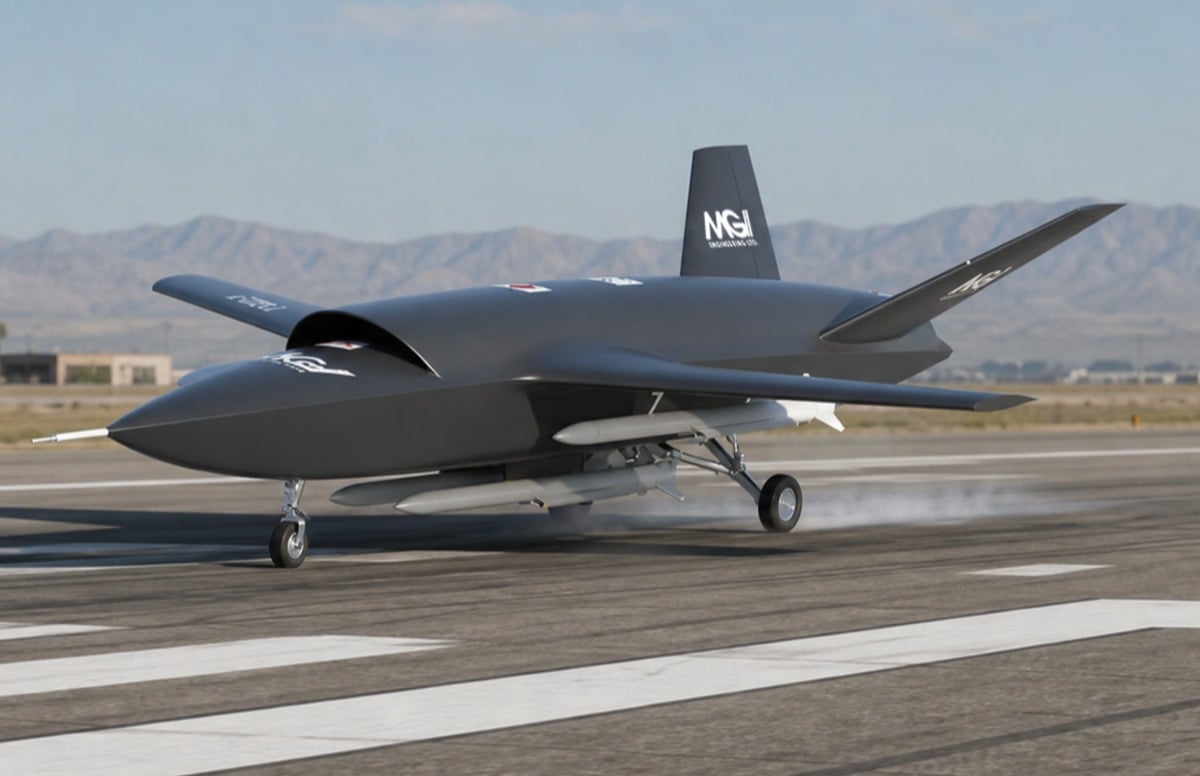
Traditional defense procurement in Western nations is broken. It takes a decade, billions of pounds, and hundreds of committee meetings to get a single missile system off the drawing board and into production. By the time it arrives on the battlefield, the enemy has already adapted, leaving military commanders holding outdated hardware that costs too much to replace.
Motorsport doesn't work like that. If an aerodynamic wing on a Grand Prix car isn't generating enough downforce, engineers design, test, manufacture, and install a replacement in six days.
That radical difference in speed is why British engineers are importing Formula 1 development philosophy into military manufacturing. Headed by former Grand Prix technical director Mike Gascoyne, UK firm MGI Engineering is turning aerospace design on its head with platforms like SkyShark and TigerShark. They aren't building delicate, multi-million-pound boutique jets. They're building attritable, low-cost attack drones at racing speeds.
Traditional Defense Procurement Is Too Slow for Modern Warfare
To understand why Grand Prix engineering matters to defense, you have to look at what's happening on modern battlefields. Electronic warfare environments change weekly. Drone pilots report that frequency bands working on Monday are jammed by Thursday.
Traditional aerospace contractors aren't built for that pace. Their design cycles rely on long sign-off processes, custom tooling, and rigid supply chains. When a threat changes, modifying an existing platform can take years of contract renegotiation.
Grand Prix teams face a similar pressure every fortnight. Between races, telemetry engineers analyze performance gaps, CAD designers tweak wing geometries, and composite shops cure new carbon parts overnight. The car that rolls onto the track in Monza rarely matches the one that raced in Monaco two weeks earlier.
Applying that approach to uncrewed aerial vehicles changes the math entirely. Instead of aiming for a perfect platform that lasts twenty years, engineers focus on rapid iteration—what defense planners call spiral development. You build a baseline model, deploy it, gather flight data, and update the design before the next production batch leaves the factory floor.
Carbon Fiber and Rapid Prototyping from Motorsport Pit Lanes
The physical overlap between high-performance race cars and long-range strike drones is larger than most people realize. Both require extremely high strength-to-weight ratios, tight aerodynamic tolerances, and optimized thermal management.
MGI Engineering leverages composite structures refined over decades in motorsport. Formula 1 monocoques must withstand massive impacts while remaining as light as possible. Drones need the same light frame to maximize payload capacity and extend operational range.
By using carbon fiber manufacturing techniques honed in race shops around Motorsport Valley in central England, workers produce drone airframes quickly without requiring massive aerospace tooling setups.
The manufacturing process skips heavy aluminum castings in favor of modular composite molds. If an updated flight test reveals a drag issue on the fuselage, technicians alter the mold in days. That agility lets small firms adapt airframes without retooling an entire assembly line.
+-------------------------------------------------------------------+
|               TRADITIONAL DEFENSE vs. F1-STYLE DRONE              |
+--------------------------+----------------------------------------+
| Feature                  | Traditional Aerospace | F1-Inspired    |
+--------------------------+-----------------------+----------------+
| Development Cycle        | 5 to 10 Years         | Weeks to Months|
| Airframe Material        | Machined Alloys       | Carbon Composites
| Unit Cost Target         | £1M - £5M+            | Tens of Thousands
| Adaptation Speed         | Very Slow             | Continuous     |
+--------------------------+-----------------------+----------------+
Battling Jamming with Motorsport Telemetry and Dead Reckoning
GPS jamming is standard practice on modern battlefields. Satellite signals are routinely spoofed or blocked across combat zones, turning sophisticated guided weapons into blind gliders.
This is another area where motorsport experience proves vital. Race cars collect gigabytes of telemetry data per lap through array networks of optical sensors, gyroscopes, and accelerometers. They don't rely on external GPS signals to measure vehicle motion, tire slip, or pitch angles inside a stadium or tunnel.
Engineers are applying those same self-contained sensor arrays to uncrewed strike platforms. By integrating visual odometry and low-cost inertial sensors originally engineered for race tracking, platforms like SkyShark can calculate their position even when GPS signals drop entirely.
The drone tracks surface movement below using optical flow and onboard processing, comparing terrain features against pre-loaded maps. If an adversary blasts high-powered electronic interference across the spectrum, the aircraft keeps flying toward its designated target without missing a beat.
The SkyShark and TigerShark Platforms Explained
MGI Engineering's primary focus sits in the one-way attack drone category—frequently called loitering munitions or kamikaze drones. These aircraft fill a specific operational gap between light quadcopters and heavy cruise missiles like Storm Shadow.
The entry model, SkyShark, delivers a 20-kilogram payload over distances exceeding 250 kilometers. It operates at subsonic speeds above 450 km/h, making it difficult for ground-based air defenses to intercept compared to slow propeller-driven drones.
MGI developed two distinct propulsion systems for the SkyShark framework:
- Micro Jet Turbine: Designed for long-range, high-speed strike roles where speed reduces intercept windows.
- Electric Propulsion with Greenjets: Designed for low acoustic and thermal signatures, allowing stealthy low-altitude penetration.
Following SkyShark, the company showcased TigerShark—a larger, more capable platform designed for extended range, heavier warheads, and higher levels of autonomous decision-making.
Instead of pricing these platforms at millions of pounds per unit, the goal is to produce them for tens of thousands of pounds. That cost profile allows military forces to deploy them in coordinated swarms, overwhelming enemy radar arrays through sheer volume rather than relying on a single, vulnerable stealth missile.
The Bottleneck of Flight Testing in British Airspace
Despite strong government interest and billions allocated toward autonomous systems in recent defense budget updates, British developers face a major practical hurdle right at home: airspace restrictions.
Testing uncrewed combat aircraft in the UK requires navigating tightly regulated civil airspace rules governed by the Civil Aviation Authority (CAA). Obtaining approval to fly high-speed autonomous jets or loitering munitions requires extensive approvals, restricted military test ranges, and strict safety corridors.
Because flight windows in Britain are heavily restricted, firms like MGI often perform ground taxi testing at local aerodromes like Enstone in Oxfordshire before packing up equipment to run actual flight trials abroad, including facilities in Spain.
This testing bottleneck slows down the exact rapid development cycle that motorsport techniques aim to create. If an engineering team has to wait months for an airspace waiver, the advantage of building a prototype in two weeks disappears. Defense advocates argue that the UK Ministry of Defence must establish dedicated, permanent uncrewed testing corridors within UK territory if it wants domestic firms to scale at pace.
How Ukraine Changed the Defense Mindset Forever
The shift toward motorsport-style agility isn't happening in a vacuum. It's a direct response to lessons learned from the war in Ukraine.
In Eastern Europe, uncrewed platforms undergo constant evolutionary pressure. A combat drone design that works effectively in June might become completely useless by August due to rapid countermeasure updates by opposing electronic warfare units. Ukrainian defense groups routinely build, field-test, modify, and redeploy new software and hardware variations in matter of days.
This operational reality exposed a massive vulnerability in Western military-industrial doctrine. Building small quantities of exquisite, ultra-expensive weapons over multi-year timelines leaves armies vulnerable when attrition rates spike.
By adopting the agile manufacturing model of Formula 1 teams, British firms can bridge that gap. The goal isn't replacing heavy strategic platforms altogether. It's about filling out the force mix with flexible, disposable systems that adapt as fast as the adversary changes tactics.
What Needs to Happen Next
If the UK Ministry of Defence wants to turn motorsport-inspired drone concepts into real frontline operational capacity, several key moves must happen immediately:
- Establish Dedicated Fast-Track Airspace: The CAA and Ministry of Defence must create designated segregated airspace corridors inside the UK dedicated to daily, year-round autonomous drone testing.
- Shift Procurement Away from Single-Vendor Contracts: Instead of locking into 15-year sole-source supply contracts, procurement officers must issue recurring short-term delivery contracts that reward platforms undergoing continuous iterative upgrades.
- Tap Local Supply Chains in Motorsport Valley: Central England contains one of the dense collections of high-precision engineering firms, composite specialists, and rapid prototyping shops anywhere on Earth. Defense planners must actively contract these non-traditional suppliers directly rather than routing every order through legacy prime contractors.
The technology and the engineering talent already exist across the UK's motorsport industry. The main obstacle remaining is whether defense bureaucracy can match the speed of a pit crew.