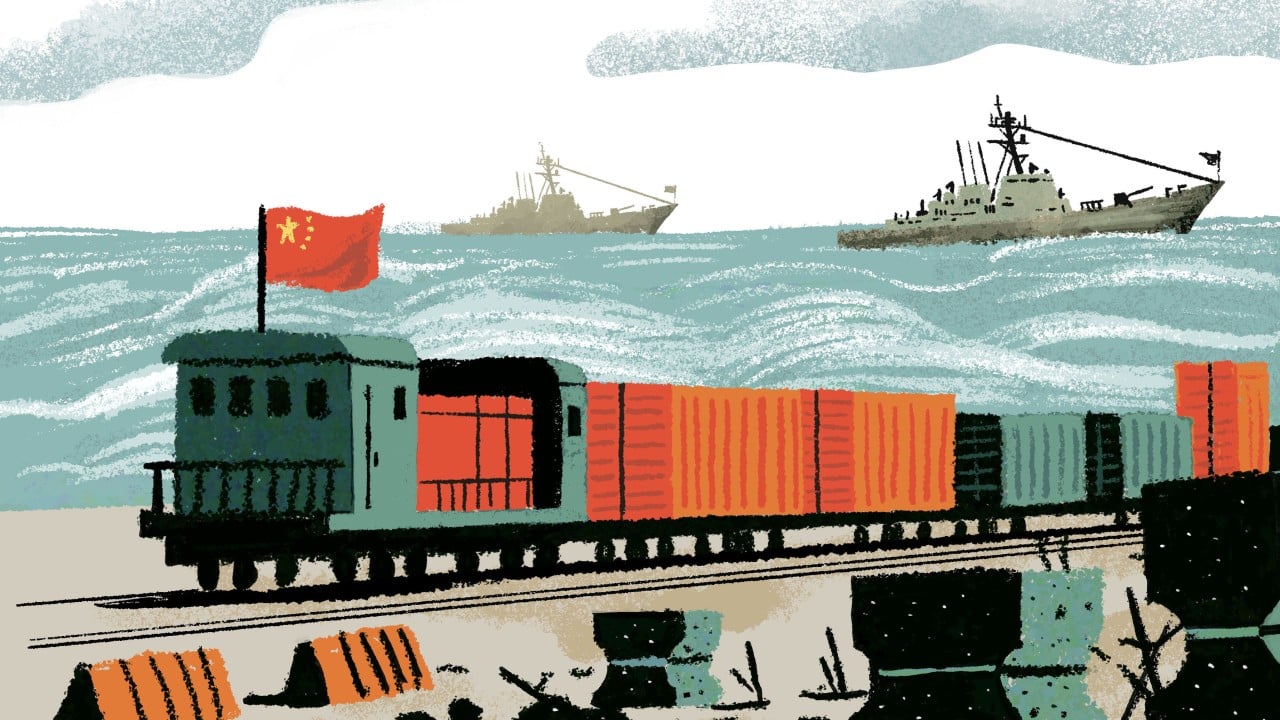
If you look at a global maritime map, China's economic vulnerability becomes clear within seconds. Around 80 percent of Chinese energy imports historically squeeze through narrow water passages like the Strait of Malacca. Throw in recent geopolitical flares in the Middle East and severe shipping halts across the Strait of Hormuz, and you get an existential nightmare for supply chain planners in Beijing.
When sea lanes close or become target zones for naval blockades and regional instability, floating tankers aren't enough. Beijing knows this. That's precisely why Chinese state-backed firms are dropping hundreds of millions of dollars into terrestrial trade corridors through Central Asia, the Caspian Sea, and the Caucasus.
It isn't just about moving cheap electronics faster. It's about ensuring energy flow, mineral access, and economic survival when ocean chokepoints freeze up.
The Bottleneck Problem Ocean Shipping Can No Longer Hide
Ocean freight used to be cheap, reliable, and straightforward. Not anymore.
Security disruptions across key maritime gateways have exposed how fragile global trade paths really are. The Red Sea crisis showed how quickly Houthi drone strikes could force commercial vessels onto a ten-day detour around Africa's Cape of Good Hope. Then, major shipping halts through the Strait of Hormuz completely cut off vital flows of oil, liquefied natural gas, and fertilizers.
For China, maritime routes are becoming a massive liability. If a major conflict breaks out or a strategic waterway gets blocked, its domestic industrial engine grinds to a halt.
Relying on the Northern Sea Route through Russia isn't a silver bullet either. European sanctions linked to the war in Ukraine make northern rail connections legally tricky and risky for international logistics operators trying to avoid Western penalty lists.
That leaves one major direction for Beijing to turn: westward across the Eurasian landmass.
What the Middle Corridor Actually Looks Like
The Trans-Caspian International Transport Route—commonly called the Middle Corridor—is the centerpiece of this land-based strategy.
Instead of routing cargo entirely by sea around South Asia or relying strictly on Russian rail lines, the Middle Corridor runs directly west. Goods move from western China into Kazakhstan, travel across the inland Caspian Sea by cargo ferry to Baku in Azerbaijan, pass through Georgia into Türkiye, and finally enter European markets.
It sounds complex on paper because it is multimodal. Cargo has to transfer from trains to cargo ships and back onto rail lines. Yet, the time savings are hard to ignore.
- Ocean transit from eastern Chinese ports to Western Europe usually takes 45 to 60 days.
- The Middle Corridor can move freight across overland and inland sea networks in roughly 15 to 18 days.
That speed advantage changes the math for high-value freight like electronics, automotive components, and perishable items. But speed isn't the primary driver behind Beijing's cash injections—resilience is.
Following the Money Across Central Asia
Beijing isn't just sending test trains down these routes; it's pouring capital directly into the ground and ports along the way.
China provided roughly $70 million in grant support alongside equipment to upgrade the Caspian Sea Port of Baku in Azerbaijan. Meanwhile, Chinese state-owned enterprises took direct equity and construction roles in a $300 million seaport expansion at Aktau, Kazakhstan.
Rail infrastructure is catching up, too. The Baku-Tbilisi-Kars railway link recently reached full operation, giving cargo trains uninterrupted steel-wheel connectivity from the Caucasus into the heart of Türkiye and Southeastern Europe.
These investments build real infrastructure capacity. Historically, Central Asian transit routes suffered from low capacity and higher freight costs per unit compared to massive container ships that carry 20,000 containers at once. Land routes can't match those economies of scale. But with Chinese capital upgrading regional dry ports, modernizing rail tracks, and standardizing customs clearing, unit costs are falling fast.
What Central Asian Nations Get Out of the Deal
This isn't a one-way street where Beijing dictates terms and everyone else simply watches. Central Asian economies have their own strategic reasons to embrace these projects.
Take Kazakhstan. Over 80 percent of Kazakh crude oil exports traditionally passed through Russian territory to reach global buyers. That dependence leaves Kazakh energy revenues subject to political decisions in Moscow. Expanding Caspian Sea transit capacity gives Kazakhstan an independent exit route to Western markets.
At the same time, countries like Uzbekistan, Kazakhstan, and Azerbaijan want to move beyond being simple exporters of raw crude and agricultural commodities. They want to become critical logistics hubs, charging transit fees, building regional manufacturing zones, and attracting foreign investment.
There's also a critical minerals angle. Central Asia holds massive, untapped reserves of copper, lithium, rare earths, and uranium—materials China needs to power its green energy supply chains and manufacturing base. Securing direct, land-locked access to these deposits insulates Beijing from external sanctions or naval interdictions.
The Real Weak Spots in the Land Strategy
Despite all the momentum, land corridors won't replace maritime shipping anytime soon. Anyone claiming China can entirely abandon ocean routes is ignoring basic logistics math.
First, capacity remains a huge bottleneck. A single ultra-large container vessel carries as much freight as hundreds of dedicated cargo trains. Moving millions of barrels of crude oil or massive bulk shipments over mountain ranges, through deserts, and across multi-border checkpoints takes immense energy and coordination.
Second, geopolitical friction doesn't disappear just because you leave the ocean.
The Middle Corridor crosses multiple international borders. Every border crossing requires customs checks, tariff negotiations, and bureaucratic alignment. A administrative dispute between neighboring countries or a localized political flare-up in the Caucasus can stall cargo trains just as effectively as an anchored naval ship in a strait.
Third, the Caspian Sea presents physical limits. It is a shallow, landlocked body of water subject to fluctuating water levels, limited port infrastructure, and seasonal weather disruptions.
How Supply Chain Managers Should React Right Now
If you handle global logistics or supply chain planning, you can't afford to ignore these emerging Eurasian land routes. Here are concrete steps to take today:
- Map your chokepoint exposure. Audit your current freight paths to see how much of your inventory passes through vulnerable maritime points like the Strait of Malacca, the Red Sea, or the Strait of Hormuz.
- Run trial shipments on terrestrial routes. Test small volumes along the Middle Corridor through Kazakhstan and Azerbaijan. Learn how customs clearing works and identify operational bottlenecks before a ocean crisis forces your hand.
- Diversify regional freight forwarders. Partner with logistics providers who have established operations and local networks inside Central Asia and Türkiye rather than relying solely on traditional maritime carriers.
- Calculate total cost of ownership vs speed. Land routes cost more per container than ocean freight, but saving 30 days of inventory holding time often offsets the transport premium for high-margin goods.
Beijing's heavy investments in Central Asian rail and Caspian ports prove that maritime security risks are no longer theoretical. The push to build overland supply routes is well underway, and global trade patterns will reflect that shift for decades to come.