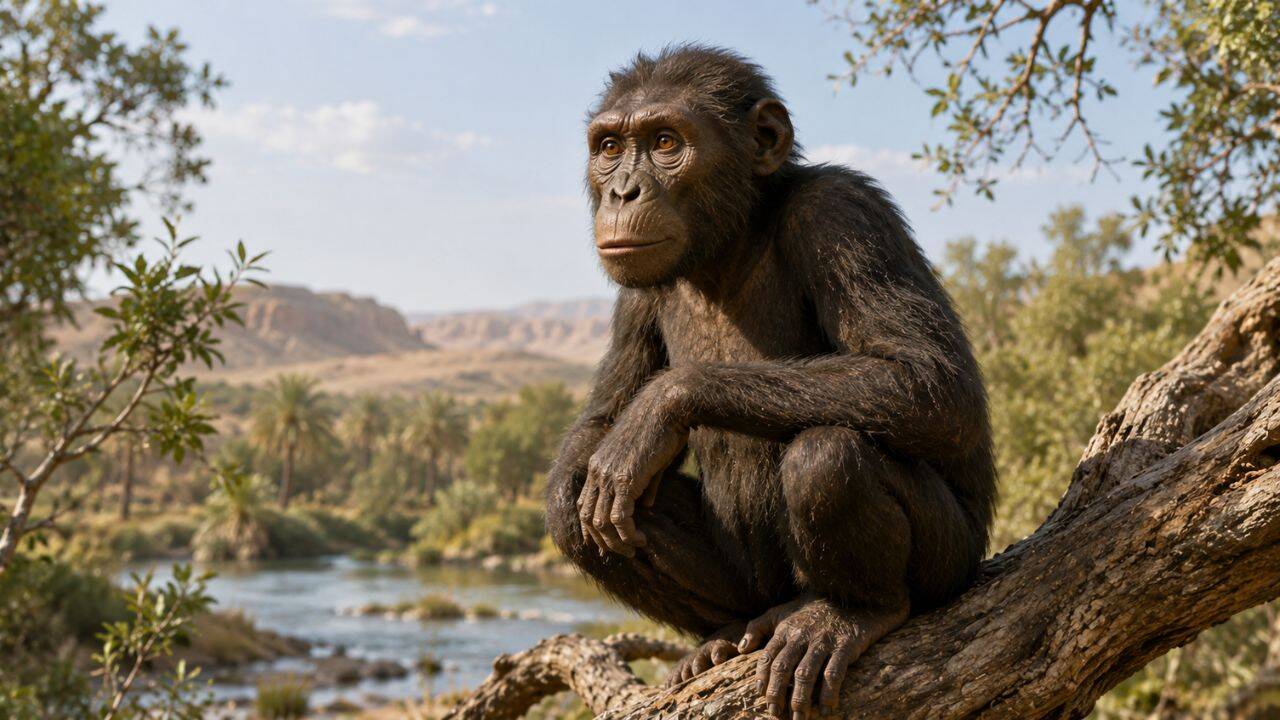
For over half a century, paleontology textbooks taught us a simple, comfortable origin story. Apes evolved in the dense, tropical forests of East Africa, hanging out in Kenya and Uganda until tectonic plates shifted and allowed them to walk into Europe and Asia.
That theory just hit a massive brick wall.
A research team led by the Mansoura University Vertebrate Paleontology Center in Egypt and the University of Southern California unearthed a 17-to-18-million-year-old fossilized jawbone in northern Egypt. The new species, named Masripithecus moghraensis, represents the first confirmed fossil ape ever found in North Africa.
This isn't just another fossil to add to a museum display case. The study, published in the journal Science, suggests that the evolutionary bridge leading directly to modern apes and humans didn't start deep in East Africa's interior. It likely ran right through the arid, scrubby crossroads of North Africa and the Middle East.
If you want to understand how your ancestors survived climate shifts, spread across continents, and eventually produced living hominids, this Egyptian jaw bone is the missing link everyone overlooked.
The Desert Site That Everyone Ignored
For decades, fossil hunters focused almost all their energy on the Great Rift Valley. East Africa was rich with fossil beds, yielding famous specimens that shaped our entire understanding of primate history. Meanwhile, North Africa was largely written off as a wasteland for early ape evolution. Researchers kept finding ancient monkeys in northern sites, but zero true apes.
That geographic gap bugged paleontologists like Dr. Hesham Sallam for years.
Sallam and his team spent five straight years scouring the windswept badlands of Wadi Moghra, a harsh depression in northern Egypt. Between 2023 and 2024, they finally hit paydirt. They pulled out a heavily mineralized lower jaw fragment featuring remarkably preserved teeth.
They named the genus Masripithecus, combining "Masr" (the Arabic name for Egypt) with "pithekos" (the Greek word for ape). The species name, moghraensis, pays homage to the dry valley where it lay buried for nearly 18 million years.
What a 17 Million Year Old Jaw Tells Us About Ancient Life
You might wonder how a single broken jawbone can derail decades of established science. In paleontology, teeth are absolute goldmines of biological data. They tell us what an animal ate, how strong its bite was, and how it fits into the broader family tree.
The jaw of Masripithecus carries a very specific set of physical traits:
- Massive canines and premolars: The front chewing teeth were notably enlarged compared to other primates living at the time.
- Textured molar surfaces: The crowns of the molars were low and covered in deep, intricate wrinkles rather than sharp, high crests.
- Thick jaw architecture: The jawbone itself was exceptionally deep and built to withstand heavy, repetitive mechanical stress.
What does that mean in plain English? It means Masripithecus was an absolute dietary generalist.
During the Early Miocene epoch, northern Africa was undergoing significant climatic shifts. The endless lush rainforests were breaking up, replaced by seasonal environments with unpredictable rainfall. While East African apes were adapted mostly to soft, abundant tropical fruits, Masripithecus had the physical equipment to grind through tough seeds, hard nuts, and fibrous plant stems when preferred soft fruits vanished during dry seasons.
That chewing flexibility allowed this species to thrive along the ecological edge where Africa met Eurasia.
Rethinking the Ape Family Tree
When the team plugged the physical measurements of Masripithecus into evolutionary models alongside genetic data from modern apes, the results surprised almost everyone.
Statistically, Masripithecus sits closer to "crown hominoids"—the evolutionary group containing gibbons, orangutans, gorillas, chimpanzees, and humans—than any early ape discovered in East Africa from the same time period.
"When we look closely at the early ape family tree, it becomes clear that something is missing, and North Africa holds that missing piece," noted Dr. Hesham Sallam during the study's release.
Before this find, scientists assumed early apes stayed down south until a land bridge formed about 14 to 16 million years ago, allowing them to migrate north into Eurasia. Masripithecus proves that apes were already established in northern Egypt long before that land bridge fully stabilized. They were parked right at the gateway, adapted to changing climates, and ready to expand the moment the geography allowed it.
How This Discovery Changes Our Understanding of Primate Travel
To appreciate why this jawbone matters, you have to look at the global map during the Miocene epoch.
Ancient Migration Route (Revised Model)
[ East Africa ] ---> [ North Africa / Middle East ] ---> [ Eurasia ]
   (Early Apes)          (*Masripithecus* Crossroads)     (Later Hominoids)
The old narrative claimed a straight, simple jump from East Africa into Europe and Asia. The new data shows North Africa acted as an evolutionary incubator.
- Afro-Arabian Roots: Early primate lineages diverged in Africa over 25 million years ago.
- The Northern Gateway: By 18 million years ago, species like Masripithecus adapted to tough, seasonal environments in North Africa and the Middle East.
- Eurasian Radiation: When land connections solidified between Africa and Eurasia, these northern populations expanded rapidly, eventually giving rise to lineages across Europe and Asia.
Without North African fossils, our picture of primate history was like trying to solve a 1,000-piece jigsaw puzzle with the entire top-left corner missing.
What Paleontology Gets Wrong About Geographical Hubs
This discovery highlights a huge bias in science: searcher bias. We often think a specific region was the "center of origin" simply because that's where people spent eighty years digging.
East Africa yielded brilliant fossils because the geology there preserved bones exceptionally well and field teams spent decades working those specific rift valleys. North Africa received far less attention for early ape research, mostly because people assumed it only held ancient monkey species.
Masripithecus proves that an absence of evidence is not evidence of absence. When field researchers actually put boots on the ground in overlooked locations, the prevailing textbook theories often fall apart in a hurry.
What Happens Next in the Search for Our Origins
The discovery of Masripithecus moghraensis isn't the end of the story—it's the opening bell for a whole new era of field research in North Africa.
If you want to keep up with how human origin theories evolve over the next few years, here are three specific developments to watch closely:
- Follow the Mansoura University Team: Dr. Hesham Sallam's lab (MUVP) is actively expanding expeditions across the Qattara Depression. Watch for further publications detailing secondary skeletal remains beyond just jaw fragments.
- Track Mid-Miocene Eurasian Discoveries: Compare new fossil digs in Southern Europe and Turkey against the anatomical profile of Masripithecus. Researchers are looking for direct lineage connections between Egyptian fossils and early European hominoid sites.
- Revisit Phylogenetic Models: Evolutionary biologists are currently updating Bayesian tree models with this new North African dataset. Expect heated debates at international paleontology conferences as researchers re-evaluate older East African specimens against this new benchmark.
Keep an eye on the scientific literature coming out of North Africa. The desert is far from done talking.