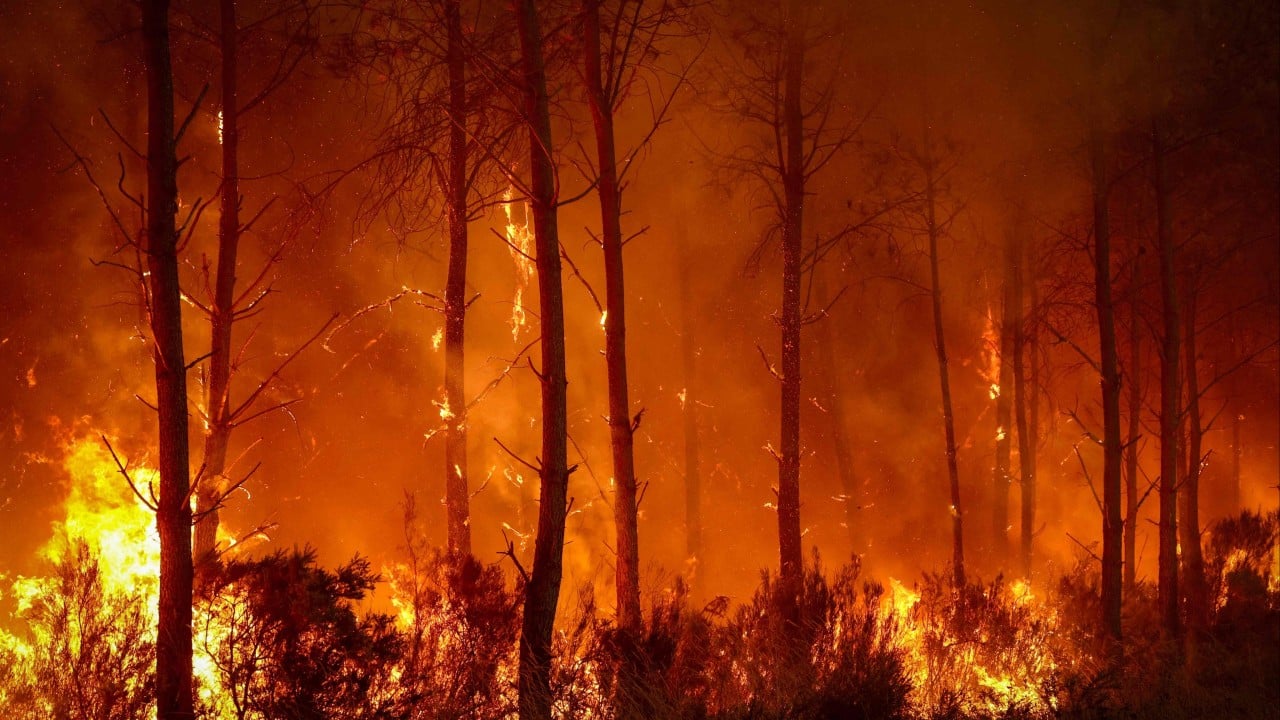
You can smell the smoke before you even cross the regional border. It hangs heavy over the highways, turning the July sun into a bruised, orange orb. Right now, firefighters across southwestern France and central Spain are fighting for survival. They're racing against the clock. Another brutal heatwave is barreling toward the continent, threatening to turn smoldering ash back into an uncontrollable front line.
Over 325,000 people have packed whatever they can fit into their trunks and fled. Campsites around Bordeaux are ghost towns. Whole villages near Madrid and Avila are locked down behind police tape. If you think this is just another standard seasonal burn, you're missing the terrifying reality of what's unfolding on the ground.
The Anatomy of a Monster Fire
What makes these blazes different from past summers isn't just the sheer acreage—though 42,000 hectares vanishing in the Gironde region alone is staggering. It's the physics of the fires themselves.
In France, the blaze near Bordeaux spawned something meteorologists hadn't witnessed locally before: a pyrocumulonimbus cloud. This isn't smoke. It's a colossal weather system generated by the fire's own intense heat. It creates its own erratic winds, sucks oxygen from miles around, and shoots lightning back down to earth. Lightning that ignites fresh fires outside the containment lines.
It's a feedback loop from hell.
Eric Brocardi, a spokesman for the National Firefighters Federation of France, called it a David-versus-Goliath scenario. When the wind shifts every ten minutes, firefighters don't dictate strategy. The fire does.
Why Southern Europe Is Kindling
You can't blame this entirely on a lack of rain, though the drought since May has left timber bone-dry. The real culprit is cumulative thermal stress. Successive heatwaves bake moisture straight out of the soil and vegetation before ecosystems can recover.
Spain's civil protection chief, Virginia Barcones, labeled the wildfire perimeter around Avila an absolute monster. We're looking at a 280-kilometer perimeter swallowing 77,000 hectares. When you have terrain this vast burning simultaneously, resources stretch thin. Water-bombing aircraft fly constant sorties, but they're slapping band-aids on a hemorrhage.
President Emmanuel Macron rushed into crisis meetings in Paris, while Spanish Prime Minister Pedro Sánchez headed straight for Valencia, where a fresh blaze forced another 15,000 people out of their homes and claimed a civilian life. Leaders are talking about structural adaptation, but right now, survival is the only policy that matters.
What Happens When the Next Wave Hits
Forecasters aren't offering comfort. Temperatures are projected to spike toward 40 degrees Celsius (104 Fahrenheit) across large swathes of the Iberian Peninsula and French wine country.
Dry lightning, fierce winds, and triple-digit heat form a toxic trio. Evacuation centers are overflowing. Tourists are being told to cancel travel plans to the southwest entirely. Locals like Georges Clivaz—who spent the weekend fighting to save his property in Saint-Jean-d'Illac with a garden hose while flames licked the treeline—know the odds are terrible.
The margins for error have vanished. Governments can deploy thousands of troops, police officers, and specialized volunteers, but until the atmospheric furnace cools down, Europe's southern forests remain on a knife-edge.
Check local civil protection alerts immediately if you're traveling anywhere near the affected regions, and respect every evacuation order the moment it's issued.
Wildfires in France and Spain force more than 250,000 people to flee homes
This video provides a firsthand look at the scale of the ongoing evacuations and the severe drought driving the fires across France and Spain.
http://googleusercontent.com/youtube_content/1