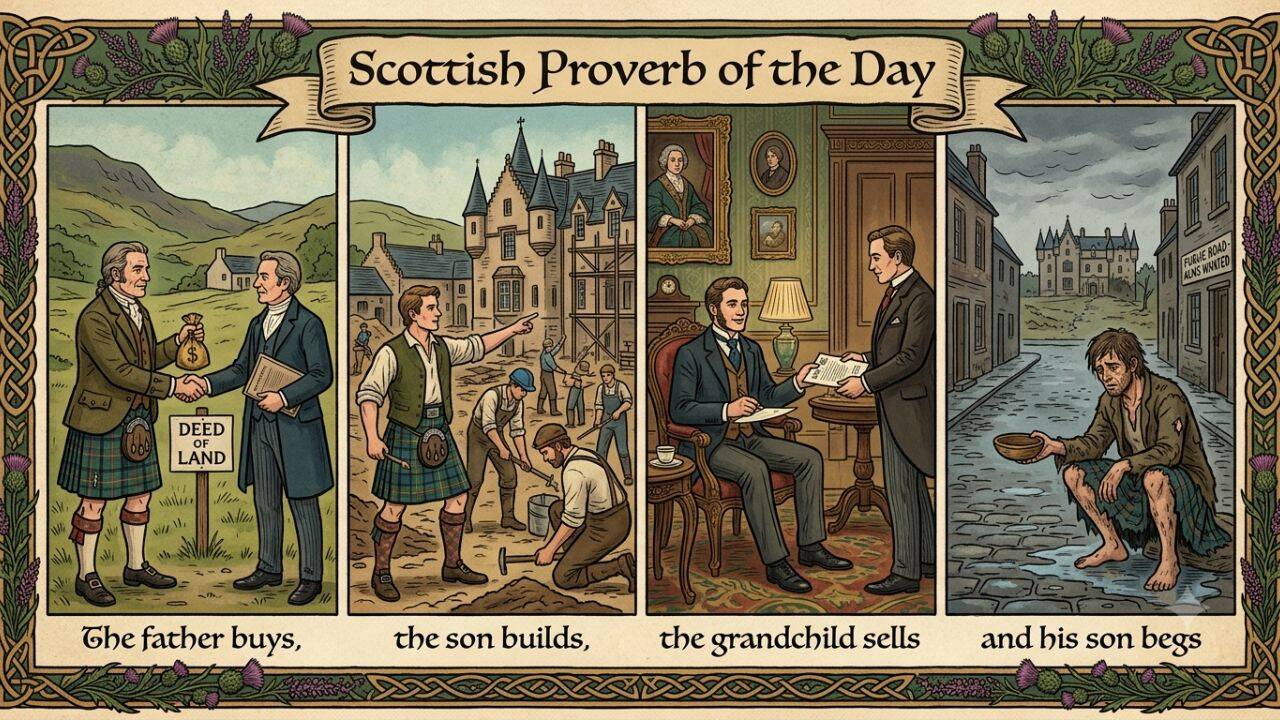
Money has a funny habit of vanishing when nobody remembers how hard it was to make. You have probably heard variations of this warning across different cultures. In China, people say wealth never survives three generations. In the American South, old timers talk about shirtsleeves to shirtsleeves. But the old Scottish proverb cuts right to the bone with brutal precision: "The father buys, the son builds, the grandchild sells and his son begs."
It maps out a complete family disaster in four simple lines. Most people dismiss it as a bleak folk saying. They miss the actual mechanics of why family wealth falls apart.
The Four Stages of the Descent
Let us look at how this cycle actually plays out in real life. It is not just about cash in a bank account. It is about psychology, hardship, and the slow erosion of discipline.
The Founder Who Buys
The first generation starts with nothing. They know cold floors, empty plates, and the crushing weight of scarcity. Because they lived through that struggle, they develop an obsessive work ethic. They sacrifice vacations, sleep, and comfort to buy land, open a shop, or acquire property. When the father buys, he is not just purchasing assets. He is buying survival. He understands the exact price of every single pound because he traded his youth for it.
The Heir Who Builds
The second generation watches the founder grind. They feel the tension in the house, but they also get to benefit from the early wins. They receive better schooling and sharper business connections. When the son builds, he takes the foundation and scales it up. He expands the operations, modernizes the approach, and turns a small family hustle into a serious enterprise. He respects the wealth because he stood right next to the person who built it.
The Grandchild Who Sells
Then things shift completely. The third generation arrives having never smelled poverty or tasted genuine hardship. They grow up surrounded by comfort, luxury, and entitlement. When the grandchild sells, they do it casually. They look at a historic family property or a thriving business division not as a sacred trust, but as liquid cash for luxury cars, risky lifestyle habits, or bad investments. They view the balance sheet as an infinite ATM.
The Descendant Who Begs
By the fourth generation, the safety net has completely evaporated. The assets are gone. The cash is burned. The great-grandchildren inherit nothing except the expensive tastes of their parents and none of the skills required to earn a living. They find themselves starting from scratch, often worse off than the original founder because they never learned how to survive.
Why Financial Discipline Cannot Be Inherited
You can hand down a deed, a stock portfolio, or a commercial building. You cannot inherit work ethic.
That is the hidden trap of generational wealth. Parents often spend all their energy protecting their money while forgetting to protect the mindset of the people who will inherit it. If you shield your kids from every single consequence, you are robbing them of the resilience they need to keep what you built.
Think about how modern family businesses operate. Statistics from institutions like the Family Firm Institute show that only about thirty percent of family businesses survive the transition to the second generation. By the third generation, that number drops to barely twelve percent. The Scottish proverb is not poetry. It is a statistical reality.
Breaking the Cycle
If you are trying to build something that lasts, you have to change how you talk about money at home. Stop hiding the struggle from your kids. Let them see what things cost. Let them fail on a small scale so they learn how to fix things on a large scale.
Wealth needs active management. It needs people who treat it with respect rather than entitlement.
Stop assuming your descendants will naturally protect what you sweat for. They won't unless you teach them how to value it.