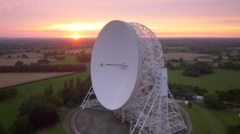
The radio dish at Jodrell Bank doesn't just look impressive sitting in the Cheshire fields. It represents a proud legacy of human curiosity that tracked Sputnik and mapped the invisible universe when most people still watched black-and-white television. Right now, that iconic heritage faces a brutal reckoning. Proposed funding reductions from the Science and Technology Facilities Council threaten to slash astronomy, particle physics, and nuclear physics budgets by roughly thirty percent.
When you pull funding from foundational facilities like Jodrell Bank, you aren't just pinching pennies on a ledger. You are risking an entire generation of scientific talent.
The Reality Behind the Cuts
The financial squeeze comes from a complex mix of escalating operational costs within national labs and shifting government priorities. Officials face tight fiscal margins and soaring expenses to keep high-tech scientific infrastructure running. Yet, targeting curiosity-driven research sends a terrible message.
Astronomers and physicists across the UK have been told to brace for severe reductions. The Royal Astronomical Society has called these proposed changes the most drastic hits to the sector in decades. Robert Massey, deputy executive director at the RAS, pointed out that you simply cannot slash budgets by thirty percent without devastating consequences.
The UK ranks third globally for the impact of its published research citations. That stellar reputation didn't happen by accident. It grew from decades of steady public backing and world-class facilities.
What Jodrell Bank Actually Does
Many casual observers think of the site as a dusty museum piece or a cool backdrop for science festivals. They miss the heavy lifting happening behind the scenes. Jodrell Bank hosts the global headquarters of the Square Kilometre Array Observatory and operates the Multi-Element Radio Linked Interferometer Network, known as e-MERLIN.
These networks link radio telescopes across the country to create a virtual instrument the size of Britain. Researchers use this setup to study pulsars, quasars, and distant galaxies with incredible precision. If the funding dries up, these national networks face immediate operational threats.
Local leaders in Cheshire East have raised alarms about the economic and educational fallout. The site attracts thousands of students every year, sparking interest in science, technology, engineering, and mathematics. Shutting down that pipeline creates a long-term skills deficit that no amount of quick corporate hiring can fix.
The Human Cost for Young Researchers
Senior scientists might weather the storm by moving abroad or shifting fields. Early-career researchers don't have that luxury. Postdoctoral positions and PhD grants take the hardest hit during budget contractions.
Dr. Lucien Heurtier, a researcher facing contract expirations, noted that university departments will hesitate to open lecturer positions in basic research if national funding is absent. Bright minds will pack their bags for countries that value long-term scientific investment. China, the United States, and various European nations are more than happy to welcome disillusioned British researchers.
Once you break an academic pipeline, repairing it takes decades. You cannot simply flip a switch and recreate a network of seasoned astrophysicists once they have left the field.
Where Things Stand Now
Local councils and scientific bodies are pushing back hard against the proposals. They are writing to ministers, lobbying members of parliament, and demanding that the government recognize the strategic value of the observatory.
The defense of Jodrell Bank isn't about sentimentality or preserving old steel structures. It's about protecting the infrastructure that keeps the nation competitive on the global scientific stage.
Protecting basic research requires vocal public support and real political commitment. If you care about technological innovation, you have to support the pure science that feeds it.
Contact your local representative, support science education initiatives, and push back against short-sighted budget cuts before the damage becomes permanent.