When politicians treat public money like a personal spending fund, taxpayers usually pay the price while politicians offer canned apologies. The latest political mess in Queen's Park centers on Brampton East MPP Hardeep Grewal, who faces intense scrutiny over how campaign and constituency dollars were funneled into his father’s local newspaper.
If you haven't been keeping track of Ontario political spending, this isn't just a minor oversight. It's a textbook example of why local governance rules need direct oversight, real financial penalties, and zero tolerance for grey-zone accounting.
The situation escalated when Ontario NDP Leader Marit Stiles submitted formal complaints to both the Integrity Commissioner and Elections Ontario. The charges point toward a double-whammy of potential ethics violations: using public office funds to advertise in a family-owned media outlet and failing to properly declare election campaign expenses during the 2022 provincial run.
Here is what happened, why the rules exist, and why this story matters far beyond Brampton East.
The Core Accusations Facing Hardeep Grewal
At the center of the controversy is Punjabi Post, a prominent daily Punjabi-language newspaper serving Peel Region. According to federal corporate records and media kit documents, the paper is directed and operated by Jagdish Singh Grewal—who happens to be MPP Hardeep Grewal’s father.
The official complaints focus on two distinct financial streams: taxpayer constituency funds and campaign spending.
┌─────────────────────────────────────────────────────────────────────────┐
│                    THE TWIN INVESTIGATION TRACKS                       │
├────────────────────────────────────────┬────────────────────────────────┤
│ INTEGRITY COMMISSIONER COMPLAINT       │ ELECTIONS ONTARIO COMPLAINT    │
├────────────────────────────────────────┼────────────────────────────────┤
│ Focus: Legislative constituency budget │ Focus: 2022 Election Campaign  │
│ Issue: Taxpayer funds spent on ads in  │ Issue: Unpaid ads, potential   │
│        his father's newspaper.         │        undeclared gifts/blackout│
│ Rule:  Members' Integrity Act 1994     │ Rule:  Election Finances Act   │
└────────────────────────────────────────┴────────────────────────────────┘
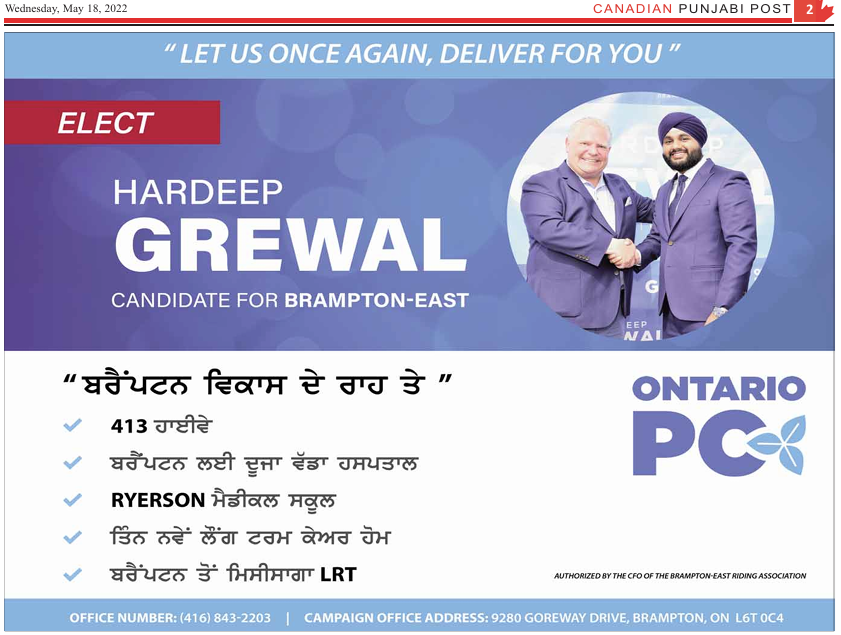
The NDP’s initial filing with Ontario's Integrity Commissioner highlighted multiple full-page and seasonal advertisements placed in Punjabi Post. These were non-partisan announcements—things like Canada Day wishes and local summer community barbecues—paid for directly out of Grewal's publicly funded legislative constituency budget.
Ontario's Members' Integrity Act, 1994 clearly states that elected officials cannot use their position to further the private financial interests of themselves or their immediate family members. When public money flows from a politician’s official constituency budget straight to a business owned by the politician’s father, the conflict of interest is obvious.
Grewal responded by claiming that Punjabi Post is a popular ethnic media outlet used by politicians of all parties and admitted he "should have consulted with the Integrity Commissioner" before placing the ads. But admitting you should have asked first doesn't change where the money went.
Unpaid Campaign Ads and Election Blackout Concerns
The plot thickened significantly when the opposition widened its investigation to Elections Ontario. Reviewing Grewal’s 2022 election campaign disclosures, the NDP noticed a startling discrepancy: no record of payments to Punjabi Post for election advertising during the campaign period.
Why is that a problem? Under the Election Finances Act, media space isn't free. If a news outlet provides free advertising to a candidate, that space is legally considered a corporate donation or a campaign gift. Corporations in Ontario are strictly prohibited from making political contributions.
If the paper ran candidate advertisements without charging, or without the campaign paying the bill, it creates an illegal financial contribution. Making matters worse, some of those advertisements allegedly ran during mandated blackout periods when all political advertising is legally banned.
Grewal's defense was that the advertisements were billed to the campaign by Punjabi Post but were "inadvertently not paid". He claimed the bill was settled years after the fact and that he reached out to Elections Ontario to correct the paperwork.
Forgetfulness is a convenient excuse in political finance. Leaving election bills unpaid for years until opposition researchers catch you isn't an administrative error—it's a massive failure of political accountability.
$27,000 in Downtown Toronto Hotels While Living in Brampton
You can't evaluate the ad scandal without looking at the broader picture. The complaint against Grewal came right as he was already under public pressure for his constituency expense filings.
Taxpayer expense disclosures revealed that Grewal claimed $27,275 in downtown Toronto hotel expenses between 2023 and 2025. He had the highest hotel expense total of any MPP in the entire province.
  Top Hotel Expense Claims Among PC MPPs (2023–2025)
  --------------------------------------------------
  Hardeep Grewal (Brampton East):      $27,275
  Nina Tangri (Mississauga-Streetsville): $19,000
  Stan Cho (Willowdale):               $16,000
Queen's Park rules permit MPPs who live more than 50 kilometers from the legislature to claim Toronto accommodation expenses. Brampton East is roughly 40 kilometers from downtown Toronto. For GTA members, hotel stays are only permitted under emergency circumstances, like severe severe winter snowstorms that prevent driving.
Expensing over $27,000 for luxury downtown Toronto stays when your home is an hour's drive away raised immediate alarms. Premier Doug Ford eventually called the spending "unacceptable" and insisted MPPs would repay the funds. Yet, the habit of treating taxpayer money like an open tab remained clear.
Why Conflict of Interest Rules Struggle in Practice
The Grewal saga exposes fundamental flaws in how provincial ethics rules are enforced in Ontario.
The "Ask Permission Later" Loophole
Right now, the system relies heavily on self-reporting. MPPs are supposed to seek advice from the Integrity Commissioner before signing contracts that involve family members. In practice, politicians often sign the contracts, spend the money, and then claim ignorance when caught.Delayed Transparency in Campaign Finances
Campaign expense audits take years to process completely. The 2022 provincial election took place years before these unpaid advertising bills were brought to light by opposition researchers. By the time the public finds out about unpaid ads or improper gifts, the election is long over and the candidate is already seated in Parliament.Weak Penalties for Financial Negligence
When caught, politicians routinely issue statements promising to pay back the funds or update their filings. Paying back money you shouldn't have spent in the first place isn't a penalty—it's just returning what you took. Without real fines or statutory sanctions, there's little incentive for politicians to audit their own expenses thoroughly before spending.
Concrete Steps to Fix Ontario's Election Spending Loophole
Fixing these recurring ethics abuses doesn't require complex legislation. It requires straightforward policy updates with strict enforcement.
Mandatory Immediate Disclosure for Family Contracts
Any constituency expenditure directed to an entity owned, operated, or directed by an immediate family member should require pre-approval from the Integrity Commissioner. Contracts executed without prior approval should be automatically voided and refunded out of the MPP's personal salary.Real-Time Digital Ledger for Campaign Ads
Campaigns should be required to publish all media ad buys on a public digital dashboard within 48 hours during an active campaign period. Outlets offering free or discounted rate space should be flagged immediately to prevent corporate gifts.Hard Cap and Distance Audits on Accommodation Spending
Strict automated distance verifications must be coded into legislative expense claims. Any claim filed by an MPP living within 50 kilometers of Queen's Park should require explicit written justification from legislative speakers before payment is disbursed.
Taxpayers shouldn't have to wait for opposition complaints or news leaks to discover where their money went. Demanding real accountability starts with replacing vague guidelines with strict, non-negotiable rules.