For four decades, marine scientists off the American coast faced an annoying limit. Standard scuba gear gave them maybe twenty minutes on a deep reef before decompression pressure forced them back to the surface. If they stayed longer, nitrogen bubbles in their blood would cause the bends, leading to severe joint pain, neurological damage, or death.
That bottleneck just broke wide open.
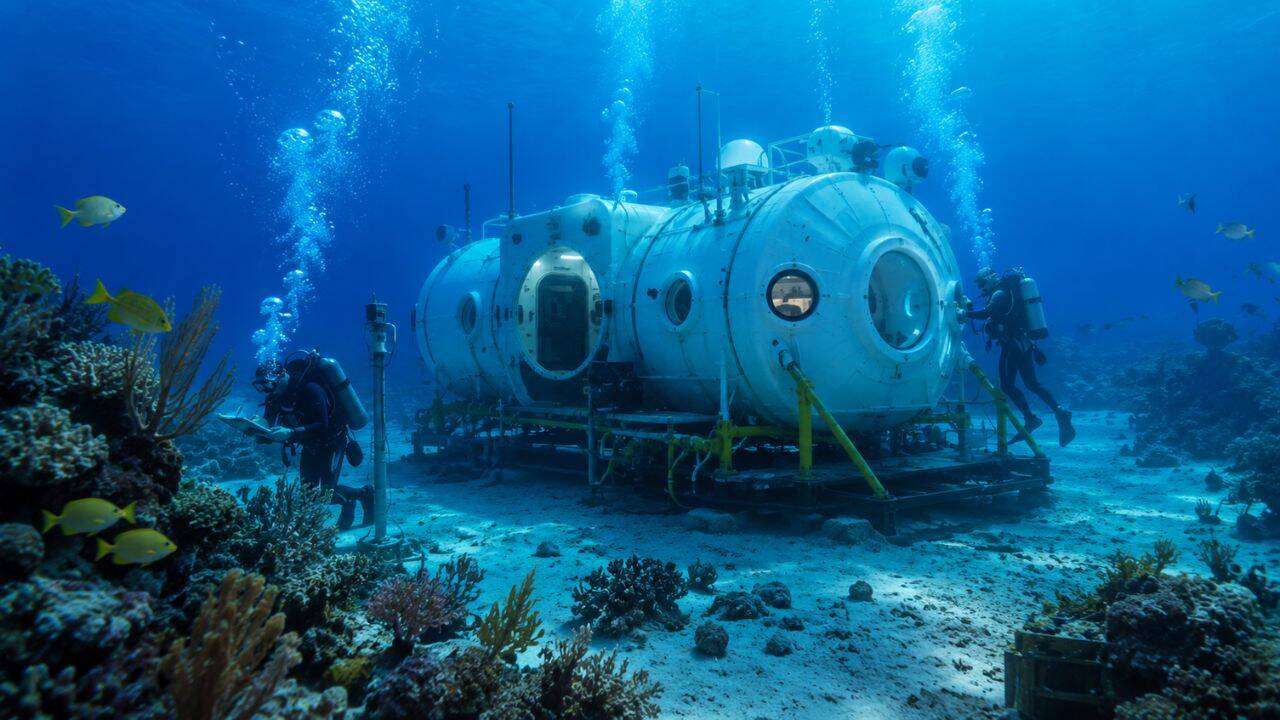
Ocean infrastructure company DEEP has anchored a new subsea outpost called Vanguard at Tennessee Reef in the Florida Keys National Marine Sanctuary. Resting 56 feet below the surface, this 35-foot-long cylinder represents the first open-ocean human habitat deployed in US waters in nearly 40 years.
It isn't a submarine. It isn't a temporary dive vessel. It's an underwater laboratory where four aquanauts will live and work for weeks at a time, stepping directly out onto the ocean floor without decompressing after every shift.
Here is what this underwater base actually means for marine biology, space analog testing, and the reality of human ocean survival.
The physics behind living under water
Most people assume living under the sea requires heavy metal bulkheads holding back crushing pressure, like a submarine. Vanguard works on the exact opposite principle: saturation diving.
Inside the habitat, internal air pressure matches the water pressure outside. Because the internal and external pressures equal out, water cannot rush in through an open hole in the floor.
This opening is called a moon pool or a wet porch. Aquanauts simply put on scuba gear, step down through the floor opening, and swim directly into the Atlantic. When their dive shift ends, they climb back up into the habitat, take off their tanks, and dry off.
Surface (1 Atmosphere)
        |
        v
Tennessee Reef Seabed (56 feet / 2.7 Atmospheres)
   +---------------------------------------+
   |   Vanguard Habitat Living Quarters    |
   |   ( pressurized to 2.7 ATM )         |
   |                                       |
   |   [ Dry Lab ] -> [ Living Quarters ]  |
   |                       |               |
   |                 [ Moon Pool ]         |
   +-----------------------|---------------+
                           |
               ( Open Water Access )
During standard scuba diving, your body absorbs ambient nitrogen as you breath pressurized air. Returning quickly to surface pressure causes that dissolved gas to expand into painful bubbles. In saturation diving, the human body absorbs all the inert gas it physically can after roughly 24 hours at depth.
Once your tissues reach full saturation, staying down for five days or thirty days makes zero difference in decompression time. Aquanauts decompress just once at the very end of their stay inside a specialized chamber.
This single engineering choice changes field research math completely. Instead of rushing through fifteen-minute work windows, scientists get ten to twelve hours of direct field work every day.
Inside the Vanguard pilot habitat
Engineering firm DEEP spent roughly 18 months designing, constructing, and testing the Vanguard unit before transporting it to Tennessee Reef.
The physical specs reveal a compact, highly functional platform:
- Total living cylinder length: 10.7 meters (35 feet)
- Internal diameter: 2.5 meters (8.2 feet)
- Operational depth: 17 meters (56 feet) below the surface
- Crew capacity: Four aquanauts per mission
- Standard mission duration: Five days minimum to several weeks
Installing the vessel on the seabed required precise marine logistics. Engineers lowered and secured a heavy structural foundation directly into a sandy patch of the ocean floor, intentionally avoiding nearby living coral beds.
They lowered the cylindrical unit down, attached it firmly to the foundation, and wired it up to a heavy-duty surface support buoy. That surface buoy feeds power, high-speed internet data connections, and fresh breathing gas mixtures down to the unit, while internal backup systems ensure safety if surface ties ever break.
The system is currently undergoing sea acceptance testing to earn formal certification from DNV, an international maritime classification society. Once DNV approves the system, support crew training starts immediately ahead of the first scientific deployments.
Why standard ocean research vessels fail short
For decades, oceanography relied heavily on surface research ships. While surface vessels handle deep-water sonar mapping well, they struggle when handling detailed, ongoing field experiments.
If a surface ship drops divers onto a reef, those divers spend 80 percent of their day prepping gear, boat commuting, and waiting out safety stops. bad weather at the surface cancels operations instantly, even if the seabed fifty feet down remains perfectly calm.
| Feature | Surface Research Vessel | Saturation Habitat (Vanguard) |
|---|---|---|
| Daily Bottom Work Time | 1 to 2 hours maximum per diver | 8 to 12 hours continuous per diver |
| Weather Dependency | Highly sensitive to surface waves | Unaffected by surface chop during work |
| Sample Handling | Samples suffer pressure changes during retrieval | Fresh samples processed at original pressure |
| Long-Term Observation | Fleeting snapshots | Continuous, 24/7 ecosystem tracking |
| Decompression Needs | Required after almost every dive | Single decompression run at mission end |
Vanguard acts as a true laboratory right on the ocean floor rather than a simple shelter where divers crash between swims.
When researchers bring delicate coral fragments or tissue samples inside, they don't subject those organisms to sudden shifts in temperature or atmospheric pressure. They analyze biological specimens inside the wet lab while cellular processes remain completely unperturbed.
What researchers will actually do down there
The primary tasks planned for Vanguard cover three core areas: marine biology, environmental technology, and human physiology.
Coral reef restoration and monitoring
Florida's coral reefs face severe pressure from warming waters, disease outbreaks like Stony Coral Tissue Loss Disease, and ocean acidification. Restoration teams usually plant lab-grown corals in tiny batches because diving time is limited. With researchers living directly on the reef, they can outplant thousands of coral fragments, run round-the-clock genetic sampling, and track how predator species interact with new coral heads in real time.
Human physiological research in extreme environments
Living underwater affects human biology in ways that closely mirror long-duration spaceflight. DEEP's scientific research director, Dr. Dawn Kernagis, highlights that pressurized habitats offer an incredible environment to study physiological stress.
Inside Vanguard, crew members breathe elevated partial pressures of gases under higher atmospheric pressure. Scientists will monitor crew members to track:
- Cardiovascular changes under constant hyperbaric exposure
- Immune system response and inflammation markers
- Shift shifts in sleep quality, circadian rhythms, and metabolic rates
- Cellular repair mechanisms that could improve hyperbaric oxygen treatments for land-based medical conditions, including chronic wound healing and gas embolisms
Astronaut training and space analog testing
Space agencies like NASA have long used underwater habitats (such as the Aquarius base) to simulate spacewalks and test lunar surface gear. The neutral buoyancy of diving closely mirrors microgravity, while the psychological isolation inside a metallic tube surrounded by a lethal environment recreates deep space mission stress. Vanguard will host similar simulation runs for astronauts preparing for moon and Mars missions.
Why US underwater habitats almost vanished
To understand why Vanguard matters, you have to look at the history of human underwater living.
Back in the 1960s and 1970s, underwater habitats were huge. The US Navy ran its famous Sealab projects, while Jacques Cousteau built Conshelf habitats in the Mediterranean and Red Sea. Scientists genuinely believed undersea cities would quickly follow.
Then funding dried up. Maintaining aging structures in harsh, salty ocean environments proved insanely expensive. Operating costs killed off habitat after habitat.
For the past several decades, the Aquarius Reef Base, located near Key Largo, stood as the world's last operational undersea research habitat. Built in the late 1980s, Aquarius kept saturation science alive almost single-handedly, but its aged infrastructure highlighted a desperate need for modern engineering.
Vanguard isn't just a replacement for legacy structures; it's a test run for much larger modular platforms. DEEP intends to use data from this pilot station to build larger, permanent subsea stations capable of housing whole research teams at depths down to 200 meters across the globe.
What happens next on Tennessee Reef
With Vanguard anchored and its structural tests moving forward, DEEP is finalizing its operations timeline:
- Finalize DNV Classification: Complete sea acceptance trials to secure safety certifications.
- Support Crew Training: Train top-side dive teams, habitat controllers, and emergency response crews.
- Inaugural Science Missions: Send the first four-person aquanaut team down for a multi-day stay.
- Live Educational Broadcasts: Beam real-time audio and video feeds directly from the seabed into school classrooms and universities globally.
If you want to track this project or get involved in ocean conservation work, here is how to take action:
- Follow official mission updates through DEEP and the Florida Keys National Marine Sanctuary.
- Support coral restoration efforts directly by engaging with regional conservation groups like the Coral Restoration Foundation or Mote Marine Laboratory.
- If you are a marine biology or hyperbaric medicine student, track research papers published out of Vanguard missions to see new field protocols for real-time cellular sampling underwater.