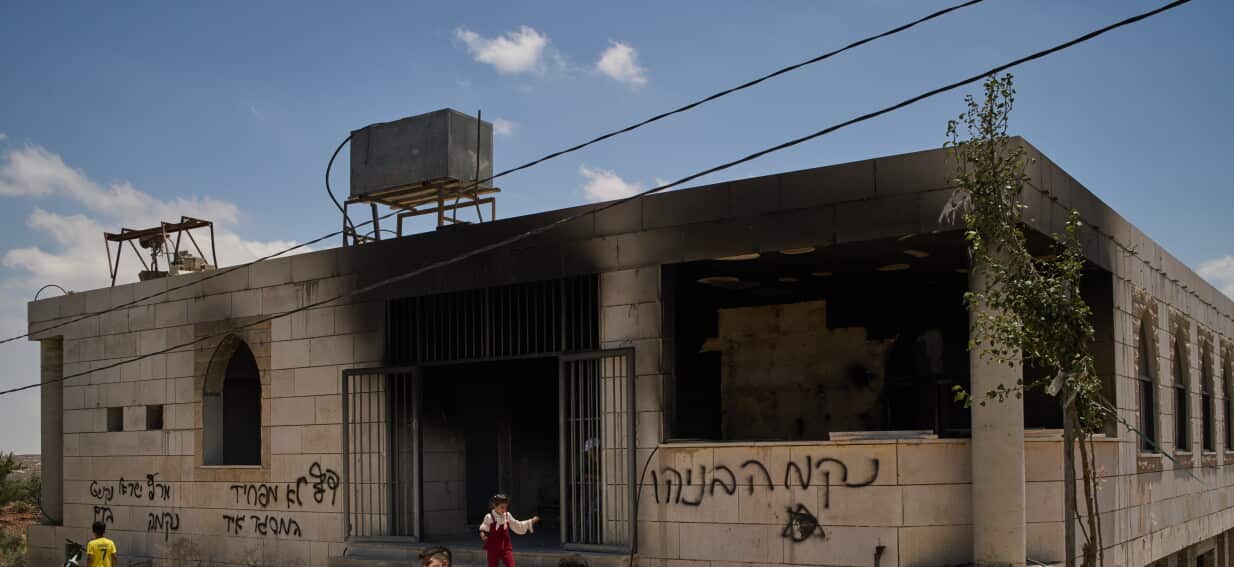
Flames lit up the night sky in the northern West Bank as two local mosques burned. This wasn't a random accident. It was a calculated act of arson carried out by Israeli settlers, leaving charred carpets, ruined entryways, and spray-painted Hebrew threats on the walls.
If you are trying to understand why the occupied West Bank feels like a tinderbox right now, look at these fires. They mark a brutal escalation in a surge of violence that has already claimed multiple lives and pushed an already volatile region to the absolute brink.
The Flashpoint Behind The Fires
Everything intensified following a deadly clash in the village of Tell, located west of Nablus. According to accounts from the ground, a group of Israeli civilians entered an area controlled by the Palestinian Authority, triggering immediate confrontations.
Rocks flew. Shots were fired. By the time the dust settled, two Israelis—including a soldier—were dead.
Retaliation was swift. Masked or civilian attackers moved under the cover of darkness into the villages of Qusra and Kour. Security footage from Kour captured three individuals planting a massive explosive device right at a mosque entrance. In Qusra, attackers torched the building and left a chilling message on the exterior: "Revenge Benayahu", referencing one of the soldiers killed days prior.
Residents woke up to devastation. Ahmed Abu Mahmoud, a 64-year-old living next to the Qusra site, watched helplessly as the flames grew too large to handle on his own. When he sought help, the response from the military stationed nearby left him stunned. Soldiers arrived, looked at the destruction, and simply left.
A Systemic Crisis Or Isolated Extremism
The Israeli government often frames settler violence as the work of a few rogue bad actors. Prime Minister Benjamin Netanyahu quickly ordered a heavy-handed security crackdown, calling for operations in what the state designates as "terror hubs". Troops flooded the territory, blocking roads, restricting movement, and arresting over 70 Palestinians over a single weekend.
Yet, critics and human rights organizations point out a glaring double standard. While sweeps and arrests target Palestinian towns en masse, rare are the instances where violent settlers face actual accountability. Palestinians and opposition leaders argue that hardline government policies give tacit approval to these radical groups.
The numbers tell a grim story. According to the Palestinian Health Ministry, dozens of Palestinians have lost their lives in the West Bank this year alone, with a significant portion attributed directly to settler attacks. Meanwhile, over 700,000 settlers now live across the West Bank and East Jerusalem, locking down land that Palestinians claim for a future state.
What Happens Next In The Region
International pressure is mounting. Palestinian President Mahmoud Abbas has appealed directly to the European Union and Arab allies, demanding immediate intervention to stop what he calls a systematic policy of displacement and terror.
Security chiefs inside Israel are issuing their own warnings. They know that unchecked vigilante violence inside the West Bank doesn't stay local. It risks sparking an entirely separate, devastating front while the military remains tied down elsewhere.
The rubble in Qusra and Kour has been swept aside for now, and residents still gathered for Sunday prayers among the scorch marks. But trust is entirely gone.
Watch the border areas closely. Pay attention to troop movements in the northern governorates. The window to prevent a full-scale regional explosion is closing fast.