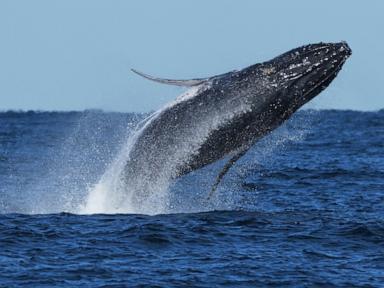
Imagine standing on a small boat off the coast of South Africa when the ocean suddenly erupts. Plumes of breath and mist shoot skyward in every direction, creating what looks like a floating concrete metropolis on the horizon. That is what wildlife photographer Chris Fallows and his wife Monique witnessed when they stumbled upon an astonishing gathering of nearly 300 humpback whales.
It is a rare spectacle. It is also proof that conservation efforts can actually work.
Decades after a global commercial hunting ban took effect in 1986, southern hemisphere humpback populations have bounced back dramatically. Numbers have surged from under 10,000 individuals during the darkest days of industrial whaling to more than 100,000 today. Yet, even as these majestic animals reclaim the oceans, fresh geopolitical threats thousands of miles away are putting their fragile recovery at risk.
The Rise of the Supergroup
Humpbacks are normally solitary creatures or travel in tight, small pods. But when food is dense and abundant, they break the rules. They congregate in massive assemblies known as supergroups.
Scientists note that these extraordinary gatherings started reappearing around 2012. Dr. Els Vermeulen, chief scientist at the University of Pretoria's Whale Unit, calls the whaling moratorium one of the greatest conservation wins in marine history. When these whales feed together, they create complex acoustic signals underwater that draw even more animals into the fold.
You see a Manhattan skyline of blowhole plumes. You hear a symphony of low-frequency calls echoing across the deep blue. It sounds like a pristine wildlife triumph. But zoom out, and the picture gets complicated.
The Ripple Effects of Mideast Conflict
While humpbacks have made an incredible comeback, other marine species are not so lucky. The World Wildlife Fund points out that out of fourteen great whale species, seven remain classified as vulnerable or endangered. Take North Atlantic right whales, for instance, which are staring down extinction with roughly 380 individuals left.
Even more alarming is how human conflicts on land translate to hazards at sea.
Recent assessments reveal that commercial shipping traffic around the southern tip of Africa has quadrupled since late 2023. Why? Because security crises and regional warfare in the Middle East—sparked by conflicts involving the Red Sea, the Houthi attacks, and escalating tensions tied to Iran—have forced cargo carriers to abandon traditional shortcuts.
Instead of passing through high-risk zones, massive container ships are diverted around the African coastline. That means thousands of extra steel hulls churning through critical whale habitats.
Invisible Collisions
Most people don't realize what happens when a massive cargo vessel strikes a whale. Because injured or dead animals frequently sink straight to the ocean floor, formal tracking data remains sparse.
Ask local environmental managers in Cape Town, however, and you will hear a different story. Gregg Oelofse, the city's coastal and environmental manager, notes that whale carcasses washing ashore often bear the unmistakable scars of industrial propellers. You see deep, lethal gashes carved right through the animal's flesh.
More ships equal higher collision rates. It is a brutal equation.
Marine biologists are actively lobbying for strict maritime speed limits and dedicated vessel routing to protect these rebounding populations from sudden traffic spikes. Without intervention, geopolitical friction halfway across the globe will continue to claim innocent victims beneath the waves.
Protecting marine life requires looking beyond local conservation zones. If you want to support ocean safety, advocate for international maritime speed restrictions in high-density wildlife corridors and back organizations tracking global vessel movements.