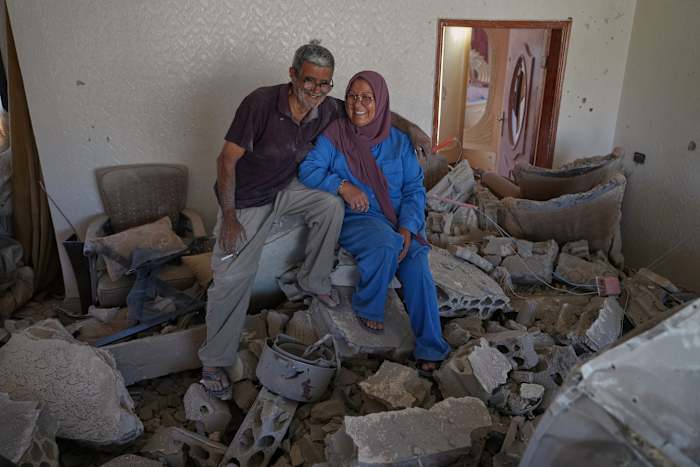
Nine plates. That is all Mahasen Faqih managed to salvage from her kitchen after returning to her shattered home in Zawtar al-Gharbieh.
The ceiling of her sitting room has caved in. Dust coats the remnants of forty-five years of life. Yet Faqih and her husband, Mohammed Sobeih, refuse to leave. They are back, settling straight into the concrete shell of the grocery shop they own downstairs while they wait for bulldozers to clear the wreckage.
They are part of a very small wave of residents trickling back under a fragile, U.S.-brokered pilot zones agreement between Israel and Lebanon. The deal is meant to test the waters of withdrawal and military handovers. Right now, it looks less like a triumphant homecoming and more like a cautious, tense occupation of ruins.
What the Pilot Zones Deal Actually Entails
The agreement hinges on a simple trade-off on paper. Israel agreed to roll back its military footprint in select southern sectors, while Lebanon's state framework moves to disarm the Iran-backed Hezbollah militant group in those areas. Zawtar al-Gharbieh is one of the initial three zones handed over to the Lebanese army.
The reality on the ground is messy. Critics in Lebanon point out a glaring logistical oddity: Israeli boots weren't even heavily stationed inside many of these pilot zones prior to the handover, meaning the physical "withdrawal" is largely nominal for parts of the territory. Troops remain positioned just outside the village limits. Drones buzz constantly overhead.
For the people living there, safety is an abstract concept.
"We don't have safety, not even 1%," Faqih says, looking out over a landscape marked by bullet-riddled mirrors and collapsed roofs. "I am not happy with the situation at all."
A Ghost Town of 500 Homes
A week after the Lebanese army moved in with armored personnel carriers and clearing machinery, only about 15 families have actually returned to Zawtar al-Gharbieh.
The math of the destruction is staggering. According to local mayor Abed Ezzeldine, nearly half of the village's 500 homes are completely destroyed. Others stand upright structurally, but they are hollow shells—stripped of windows, doors, and structural integrity by heavy shelling.
Water arrives sporadically via tanker trucks arranged by the stretched local municipality. There is a partially destroyed blue-domed mosque anchoring the main square, flanked by military vehicles. Just a hundred meters down the road, a blocked passage leads directly into Zawtar al-Sharqiyah, a neighboring village that remains fully occupied by Israeli forces.
Israel Defense Minister Israel Katz stated publicly that across southern Lebanon, dozens of villages have seen extensive demolition because they served as strategic staging points for Hezbollah. For families returning, political strategies matter very little. They care about walls, roofs, and survival.
The Financial Trap of Repeated War
Rebuilding in southern Lebanon has become an impossible financial loop.
Faqih notes that she already poured twenty thousand dollars into repairing her home following the 2024 conflict. To fund those repairs, she sold her jewelry. Now, that money is gone, the jewelry is gone, and the house is flattened entirely.
Most residents face the same grim arithmetic. Insurance does not exist for war zones. International aid is slow and bottlenecked by bureaucracy. Families are forced to choose between abandoning their ancestral land entirely or sleeping among commercial debris while waiting for state compensation that rarely arrives on time.
What Comes Next
Technical teams from Lebanon and Israel are heading to Rome for another round of talks aimed at expanding these pilot zones village by village.
Yet locals are exhausted by the glacial pace. If the military withdrawal inches forward by just one village every couple of months, residents argue it will take generations to reclaim the south. Hezbollah strongly opposes the framework and the direct negotiations altogether, creating an internal political pressure cooker for anyone cooperating with the state rollout.
Despite the fear, despite the drone noise, and despite the lack of running water, people like Faqih sleep in their shops. They sleep there because abandoning the land means losing it forever.